


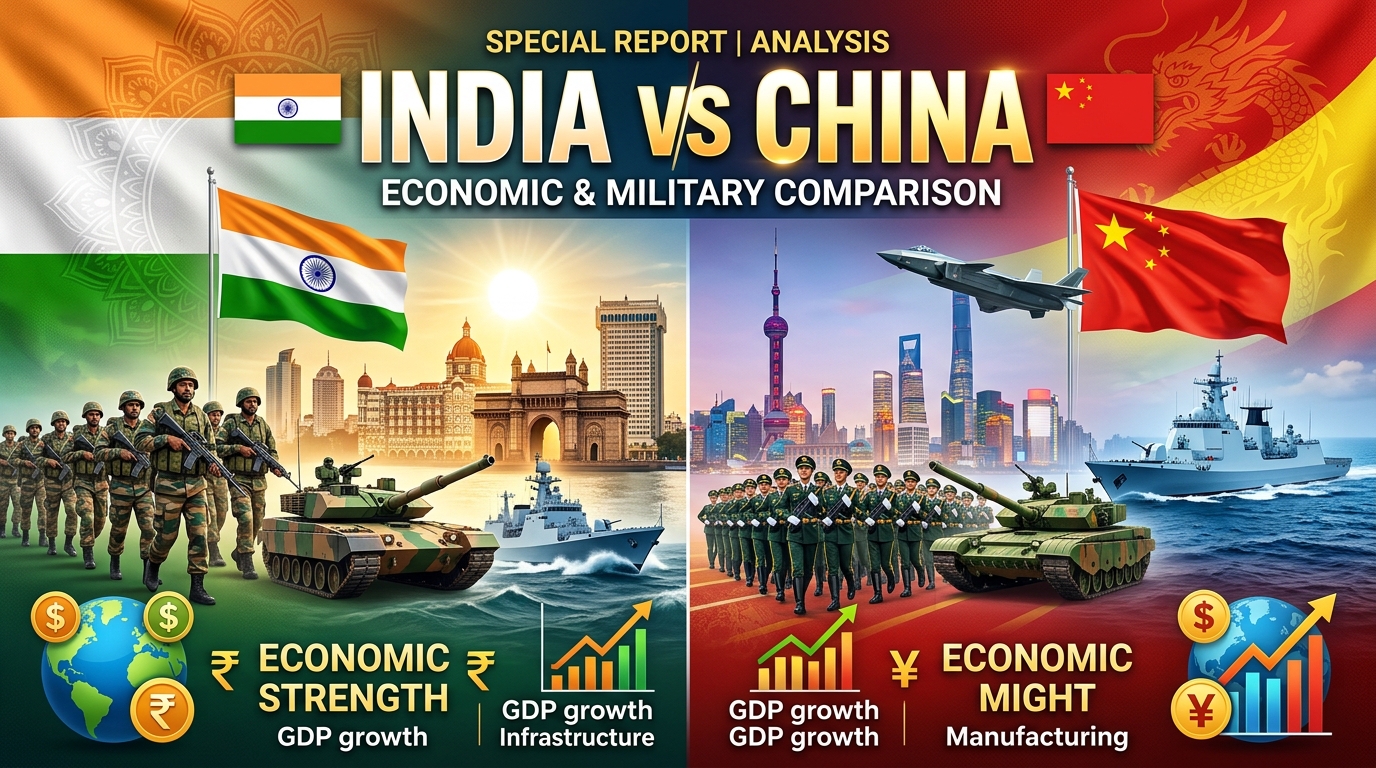
Over the past two decades, the global balance of power has increasingly been shaped by the rise of two Asian giants: India and China. Both nations have large populations, expanding economies, and growing geopolitical influence. While China emerged earlier as an economic superpower, India is now rapidly rising and positioning itself as a major global player.
This comparison explores the economic strength and military capabilities of the world’s two most populous countries and examines what their rivalry could mean for the future.
Economic Power: China’s Lead vs India’s Growth
China currently has one of the largest economies in the world. Decades of rapid industrialization and export-driven growth transformed the country into a global manufacturing hub. Chinese companies dominate sectors such as electronics, infrastructure, and global trade.
India’s economy, while smaller, is growing quickly. Economic reforms, a strong service sector, and a rapidly expanding digital economy have helped India become one of the fastest-growing major economies. With a young population and rising consumer demand, India has significant long-term growth potential.
Many global institutions such as International Monetary Fund and World Bank have predicted that India could become one of the world’s largest economies in the coming decades.
Key Economic Differences
China
- Strong manufacturing base
- Massive export economy
- Advanced infrastructure
- Large foreign exchange reserves
India
- Rapidly growing services sector
- Strong IT and digital economy
- Large domestic market
- Expanding startup ecosystem
While China remains economically ahead, India’s growth trajectory suggests it could narrow the gap over time.
Military Strength: Strategic Rivalry
Both India and China possess powerful military forces and nuclear capabilities. Their strategic competition has intensified in recent years, especially along the disputed border in the Himalayas.
China’s military modernization has been rapid. The country has invested heavily in advanced weapons systems, naval expansion, cyber warfare capabilities, and space technology. China also has one of the world’s largest defense budgets.
India, meanwhile, continues to modernize its armed forces and strengthen defense partnerships with global allies. The Indian Armed Forces have focused on improving air power, naval capability, and border security.
Both countries maintain nuclear arsenals and advanced missile systems, which makes their rivalry strategically significant.
Technology and Innovation
Technology is another major area of competition between the two nations.
China has made significant progress in areas such as artificial intelligence, electric vehicles, and semiconductor manufacturing. Its large investments in research and development have positioned it as a global technology leader.
India is also emerging as a technology powerhouse, particularly in software development, startups, and digital infrastructure. Organizations such as the Indian Space Research Organisation have demonstrated India’s growing capabilities in space exploration and satellite technology.
India’s digital ecosystem, including fintech and online services, has also expanded rapidly.
Geopolitics and Global Influence
The rivalry between India and China extends beyond economics and military power. Both countries are working to increase their global influence through diplomacy, trade partnerships, and strategic alliances.
China has invested heavily in international infrastructure projects through initiatives such as the Belt and Road Initiative. India, meanwhile, has strengthened partnerships with countries across Asia, Europe, and the United States while expanding its presence in international organizations.
Regional tensions and strategic competition will likely continue to shape the relationship between the two nations in the coming decades.
The Road Ahead
The competition between India and China will be one of the defining geopolitical stories of the 21st century. China currently holds an advantage in economic scale and manufacturing power, while India benefits from a younger population, democratic institutions, and a rapidly growing technology sector.
As both countries continue to develop, their economic policies, military strategies, and technological innovation will play a crucial role in shaping the future balance of global power.
For observers and policymakers alike, the evolving relationship between these two nations will remain a key factor in understanding the future of Asia—and the world