
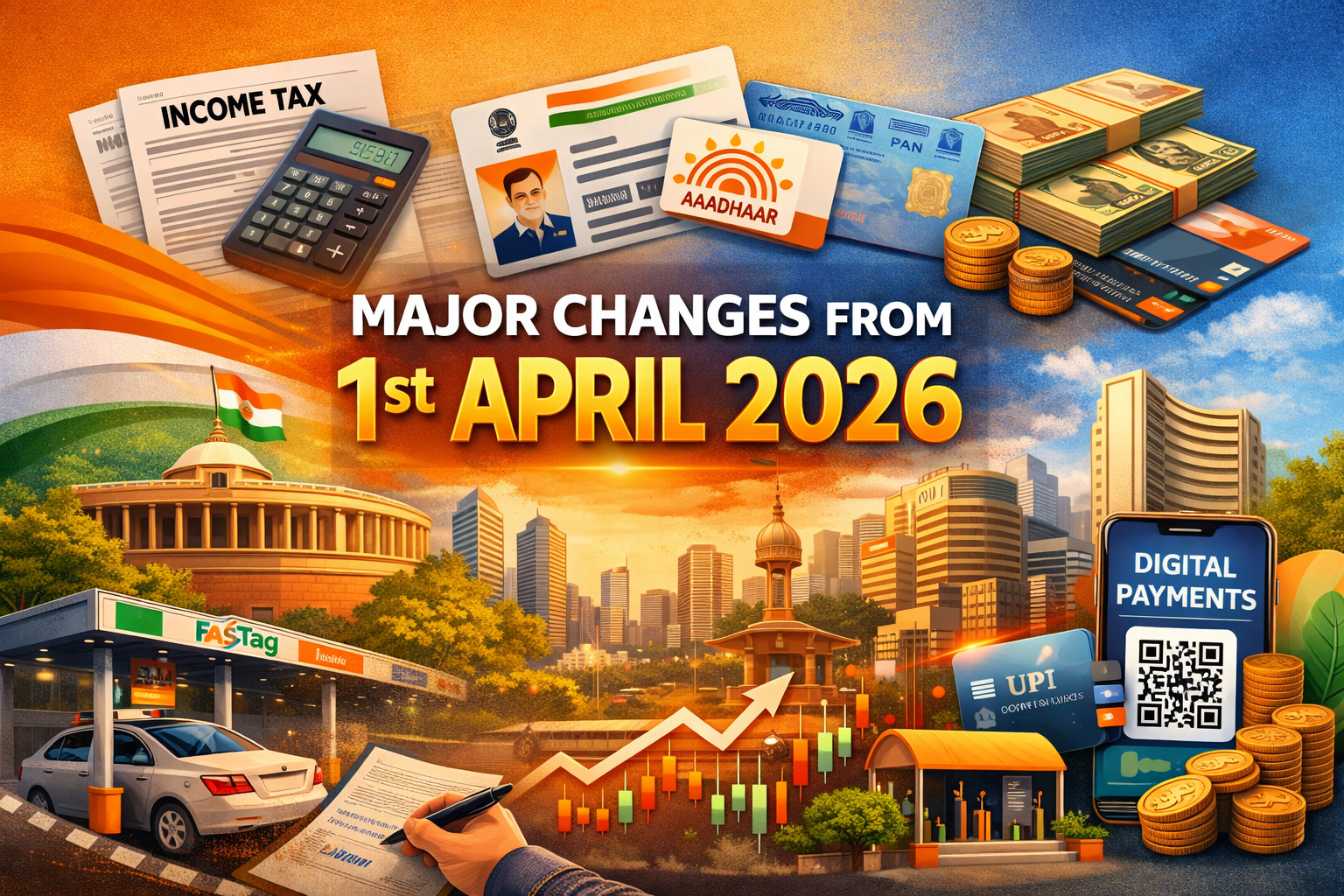
Every year, 1st April marks the beginning of a new financial year in India — and 2026 is bringing some major changes that will impact taxpayers, businesses, and daily life.
From new income tax rules to PAN changes and digital payment updates, here’s a complete breakdown of what’s changing from April 1, 2026.
1. New Income Tax System Comes Into Effect
The biggest change is the implementation of the new Income Tax framework.
Key Highlights:
- New rules under Income Tax Act 2025 apply from April 1, 2026
- Simplified tax system with clearer calculation methods
- Focus on reducing confusion and disputes
Big Benefit:
- Income up to ₹12 lakh may be tax-free (under new regime)
This is one of the biggest tax reforms in decades
2. Major Changes in Salary & Perks Taxation
What’s changing:
- New formulas for calculating:
- Salary perks
- Company benefits
- Gifts and allowances
This will impact:
- Salaried employees
- Corporate professionals
The goal is more transparency and fair taxation
3. Credit Card Rules Get Stricter
New Rules:
- High-value transactions will be monitored closely
- PAN linking with credit cards becomes important
- Spending data may be used in tax filings
This aims to:
- Reduce tax evasion
- Increase financial transparency
4. PAN Card Application Rules Change
Key Updates:
- Aadhaar alone will NOT be enough for PAN application
- Additional documents will be required
- New PAN format may be introduced
This strengthens identity verification
5. Stock Market & Investment Changes
Important Updates:
- Share buybacks will now be taxed as capital gains
- Securities Transaction Tax (STT) increased on futures
Impact:
- Investors & traders will see tax changes in profits
6. Banking & Cash Transaction Rules
Updates:
- TDS on large cash withdrawals continues (₹1 crore threshold)
- More digital tracking of financial activity
Government is pushing towards a cashless economy
7. Toll & Digital Payment Changes
New Changes:
- Toll charges increasing in some highways (~5%)
- 100% digital toll payments (FASTag / UPI only)
No more cash lanes at many toll plazas
8. Business & Compliance Changes
What’s new:
- Easier tax filing procedures
- Simplified rules (reduced from 500+ to ~333 rules)
- Better digital compliance systems
Helps startups & small businesses
These changes show a clear direction:
- India moving towards fully digital economy
- Stronger tax tracking & transparency
- Less cash, more data-driven governance
By 2040, expect:
- Fully automated tax systems
- Minimal manual filing
- AI-based financial tracking
Final Thoughts
April 1, 2026 is not just another financial reset — it’s a major shift in how India handles money, taxes, and compliance.
Key Takeaways:
- New tax system = simpler but stricter
- Digital tracking = higher transparency
- Less cash = more accountability
Whether you’re a salaried person, business owner, or investor — these changes will directly affect you