
Narendra Modi’s Report Card: What He Promised in 2014 vs What India Got
Last Updated on May 31, 2026 9:04 pm by Rohit Gadhia
In 2014, India was ready for change.
The UPA government was tired, corruption scandals were everywhere, and a new face had arrived — Narendra Modi. With his powerful speeches and big promises, he swept the elections with a historic mandate. 282 seats for BJP alone. A majority no one had seen in decades.
But every government must eventually answer one simple question: Did you deliver?
Ten years have passed since Modi took oath as India’s 14th Prime Minister. So let’s do something simple — put the 2014 promises side by side with what actually happened. No bias. No politics. Just facts.
This is Modi’s report card.
The Big Promises of 2014 (Modi’s Report Card)
Before we judge, let’s be fair and list what Modi actually promised. The BJP’s 2014 election manifesto was titled “Ek Bharat, Shreshtha Bharat” — One India, Great India. The slogan was “Sabka Saath, Sabka Vikas.”
Here are the five biggest promises that the entire country remembers:
- 2 crore jobs every year
- Bring back black money from abroad
- Achhe Din — a better life for every Indian
- Make India a $5 trillion economy
- Farmer income to be doubled by 2022
These weren’t small promises. They were nation-changing commitments. Let’s see how each one played out.
Promise #1: 2 Crore Jobs Every Year
What was promised: Modi and BJP stated clearly that they would create 2 crore (20 million) jobs every single year. For India’s massive young population, this was the most exciting promise of all.
What actually happened: This is where the report card gets difficult.
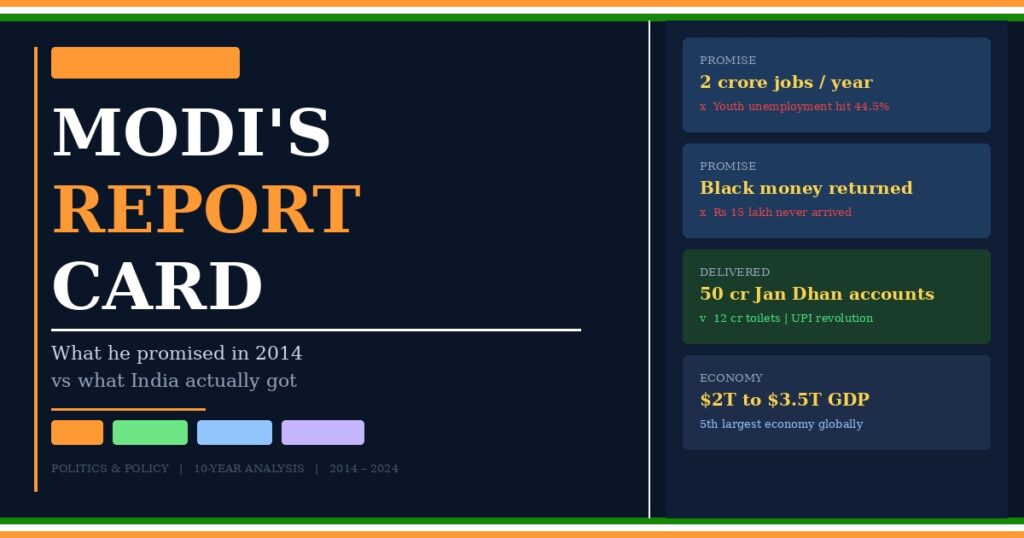
According to the Centre for Monitoring Indian Economy (CMIE), the unemployment rate among Indians aged 20–24 years hit 44.5% in late 2023. Nearly half of young Indians in that age group couldn’t find work.
The Make in India initiative — which promised to bring 10 crore manufacturing jobs by 2022 — also fell short. The Quint reported that manufacturing employment actually fell from about 5 crore people in 2016–17 to around 2.7 crore by 2020–21 — nearly half the workers gone.
Demonetisation in 2016 made things worse. Millions of jobs in the informal sector disappeared overnight when ₹500 and ₹1000 notes were banned.
Verdict: ❌ Not delivered. The jobs promise was the biggest unfulfilled commitment of the decade.
Promise #2: Black Money and the Famous ₹15 Lakh
What was promised: Modi had promised to bring back black money stashed in foreign banks. His speeches suggested that if this money came back, every poor Indian could receive ₹15–20 lakh. This became the most talked-about promise of 2014.
What actually happened: The ₹15 lakh never arrived in anyone’s account. BJP president Amit Shah later called it a “jumla” — meaning a rhetorical statement, not a literal promise.
To be fair, the ₹15 lakh figure was never in the official BJP manifesto. It was a statement Modi made at rallies about the potential value of black money if recovered. The opposition turned it into a promise; the BJP later disowned it.
But on the actual goal — recovering black money from abroad — the results were minimal. No major repatriation of funds happened. Indians continue to hold money in offshore accounts.
Verdict: ❌ Not delivered. Whether or not it was a formal promise, the expectation was set and not met.
Promise #3: Farmer Income Doubled by 2022
What was promised: In 2016, Modi announced a clear goal — double farmers’ income by 2022. This was a specific, time-bound commitment to rural India.
What actually happened: A government committee calculated that to meet this goal, farm income needed to grow at 10.4% per year. Scroll.in reported that as of 2021, annual growth in farm income was just 2.8% — far below what was needed.
The demand for MGNREGA (the rural employment guarantee scheme) also reached record highs in recent years — which is usually a sign of rural distress, not prosperity.
Verdict: ❌ Not delivered. Farm income did grow, but not at the promised pace.
Promise #4: $5 Trillion Economy
What was promised: Modi set an ambitious target — make India a $5 trillion economy by 2024–25.
What actually happened: India’s GDP has grown significantly under Modi. As per Zee Business, India’s economy grew from $2 trillion in 2014 to about $3.5 trillion by 2024 — a 162% growth. India did move from the “Fragile Five” to the 5th largest economy in the world.
But the $5 trillion target by 2024–25 was missed. COVID-19 played a role — GDP actually contracted by 7.3% in 2020–21. However, even before the pandemic, growth had slowed to 4.18% in 2019–20.
The target has now been pushed forward. Modi’s government is now aiming to make India the third-largest economy globally — a goal for the longer term.
Verdict: ⚠️ Partially delivered. India became the world’s 5th largest economy, but the $5 trillion target was missed.
What Modi’s Government Did Deliver
A fair report card must acknowledge the real achievements too. And there are several significant ones.
✅ Jan Dhan Yojana — Banking for All
Before 2014, nearly half of India had no bank account. The Pradhan Mantri Jan Dhan Yojana changed that. According to the government, over 50 crore bank accounts were opened. This enabled direct benefit transfer (DBT) — putting government subsidies directly into people’s accounts without middlemen eating away the money.
✅ Swachh Bharat — Toilets That Changed Lives
Over 12 crore toilets were built across India under the Swachh Bharat Mission. All states and Union Territories were declared open defecation-free. The World Health Organisation praised this effort, estimating it would save 3 lakh lives. For women in rural India especially, this was a life-changing achievement.
✅ UPI and Digital India
India today processes more digital transactions than almost any country in the world. UPI — the Unified Payments Interface — grew from near zero to over 9,500 crore transactions annually. This is a genuine revolution. A vegetable seller in a village now accepts phone payments. That’s real change.
✅ Infrastructure — Roads, Rails, and More
National highways grew by 60% over the decade. The Vande Bharat Express trains began running across India. Around 7.8 lakh km of village roads were built or improved, connecting remote areas to markets and hospitals for the first time.
✅ Ujjwala Yojana — Free Gas Connections
Over 10.33 crore poor families received free LPG connections under Ujjwala Yojana by March 2025. For women who spent hours gathering firewood and breathing smoke from wood fires, this was genuine relief.
✅ Ayushman Bharat — Health Insurance for the Poor
The Ayushman Bharat scheme provides health coverage to the bottom 40% of Indians — roughly 55 crore people. By late 2024, over 8.4 crore hospital stays had been covered, worth over ₹1.16 lakh crore. For a country where medical expenses push millions into poverty every year, this matters enormously.
✅ GST — One Nation, One Tax
The Goods and Services Tax unified India’s chaotic multi-tax system. Love it or hate it, annual GST revenue now crosses ₹20 lakh crore, and inter-state trade became simpler. This is structural reform that will benefit India for decades.
The Final Report Card
Here’s a simple summary of what was promised versus what was delivered:
| Promise | Status |
|---|---|
| 2 crore jobs per year | ❌ Not delivered — youth unemployment remained high |
| Black money recovery / ₹15 lakh | ❌ Not delivered |
| Farmer income doubled by 2022 | ❌ Not delivered — grew at 2.8% vs needed 10.4% |
| $5 trillion economy by 2024–25 | ⚠️ Partially — became 5th largest, missed the number |
| Financial inclusion (Jan Dhan) | ✅ Delivered — 50 crore accounts opened |
| Swachh Bharat / toilets | ✅ Delivered — 12 crore toilets, ODF status |
| Infrastructure development | ✅ Delivered — highways, railways, village roads |
| Digital payments / UPI | ✅ Delivered — world-class achievement |
| Free LPG for poor (Ujjwala) | ✅ Delivered — 10+ crore families |
| Affordable healthcare (Ayushman) | ✅ Delivered — 55 crore people covered |
What Does This Tell Us?
Modi’s ten years in power show a clear pattern. The government performed well on welfare delivery and physical infrastructure — things that could be planned, funded, and executed by the government machine.
It struggled on economic transformation — jobs, farm income, and making India a global manufacturing powerhouse. These things depend on private investment, global conditions, and complex market forces that no single government fully controls.
Was Modi a success or a failure? The honest answer is: both, depending on what you measure.
If you are a poor woman in rural Bihar who now has a bank account, a gas cylinder, a toilet, and health insurance — Modi’s decade improved your life in real, tangible ways.
If you are a young engineer from UP who graduated in 2018 and still can’t find a stable job — the promise of “achhe din” still feels like it hasn’t arrived.
That is the complexity of governing 1.4 billion people.
What’s Next for India?
The real question is not about 2014. It’s about 2029 and beyond. India is now the world’s most populous country and one of the fastest-growing major economies. The opportunity is enormous — but so is the pressure.
Jobs, inflation, agricultural reform, and quality education remain the unfinished agenda. Whoever leads India next — Modi or someone else — will need to answer these questions with more urgency.
India’s future depends on it.
Also Read (Internal Links)
- 🔗 India Slipped to 6th Largest Economy: Temporary Setback or Bigger Concern?
- 🔗 Delimitation Bill 2026: What It Is, Why South India Is Furious & What Happens Next
- 🔗 BJP Income and Assets: From ₹122 Crore to ₹7,113 Crore — The Full Story
External Sources Referenced
- BJP 2014 Manifesto — Official
- Al Jazeera — Five Years of Modi: Economic Report Card
- CMIE — Youth Unemployment Data
- BoomLive — ₹15 Lakh Fact Check
- Zee Business — 10 Big Achievements
- Organiser — 11 Years of Modi Government
📢 Disclaimer: This article is intended for informational and educational purposes only. India2040 presents a balanced, fact-based analysis based on publicly available data and credible sources. We do not endorse or oppose any political party or leader. Readers are encouraged to verify facts independently and form their own informed opinions. All data cited is sourced from publicly available reports, government statements, and credible media organisations.

India2040 Desk is the editorial team of India2040, covering technology, startups, business, infrastructure, trade, and innovation shaping India’s future. The team focuses on reporting developments that contribute to India’s growth, digital transformation, and long-term vision toward 2040.
About The Author