
Raghav Chadha Joins BJP: 7 AAP Rajya Sabha MPs Quit in Biggest Blow to Kejriwal
Last Updated on May 31, 2026 9:04 pm by Rohit Gadhia
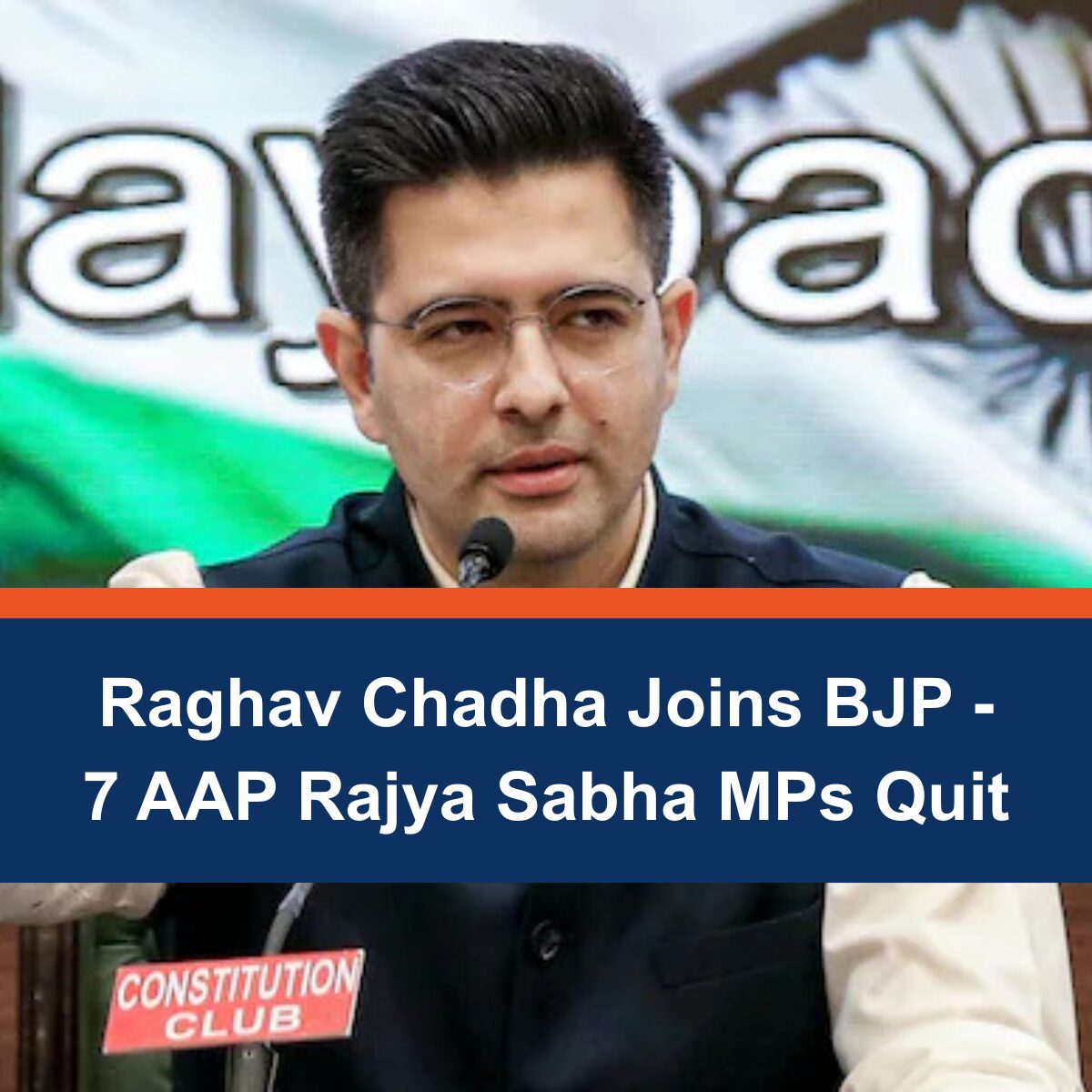
It is April 24, 2026. And in a single press conference held this morning, the Aam Aadmi Party lost more than two-thirds of its Rajya Sabha MPs in one shot.
Raghav Chadha, once Arvind Kejriwal’s most trusted and articulate spokesperson, walked up to a microphone — flanked by Sandeep Pathak and Ashok Mittal — and announced that he was done with AAP.
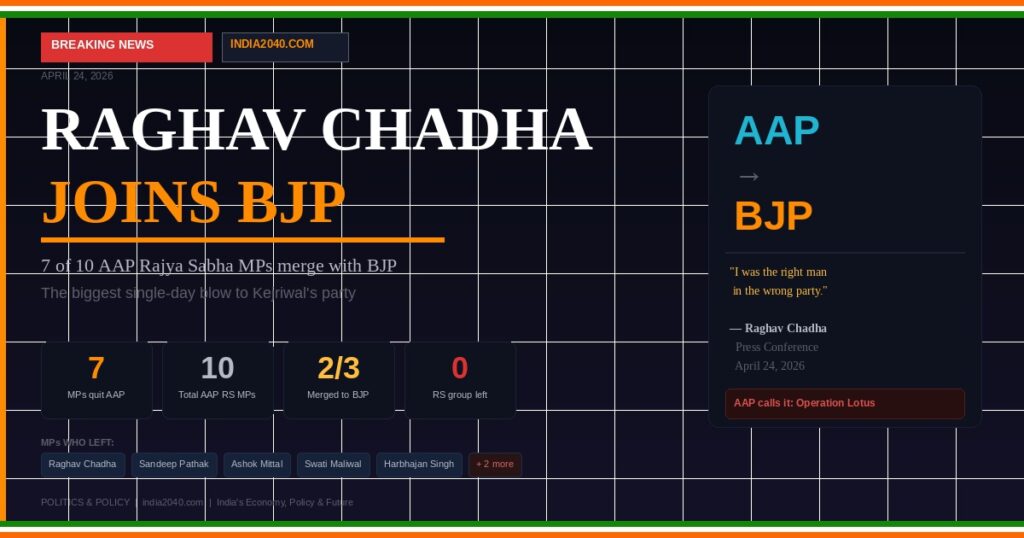
Not just done. He called the party corrupt. He called it compromised. He said he spent the last year of his political life in the “wrong party.” And then he announced that Raghav Chadha joins BJP along with six other Rajya Sabha MPs — exercising a constitutional merger provision that immediately strips AAP of its Rajya Sabha group.
In a matter of hours, the Aam Aadmi Party — once the most exciting political movement in India — lost its entire presence in the upper house of Parliament.
This is the full story of what happened today, why Raghav Chadha joins BJP and what it means for Indian politics.
What Happened Today: The Breaking News – Raghav Chadha joins BJP
At a press conference on the morning of April 24, 2026, Raghav Chadha announced that he, along with Sandeep Pathak and Ashok Mittal, was quitting the Aam Aadmi Party and merging with the BJP.
In his statement, Chadha said:
“There are 10 AAP MPs in the Rajya Sabha. More than two-thirds of them are with us in this. They have signed, and this morning we submitted the signed letter and documents to the Rajya Sabha Chairman.”
He named the other MPs who had joined the move: Harbhajan Singh, Swati Maliwal, Rajinder Gupta, and Vikramjit Singh Sahney.
That is 7 out of 10 AAP Rajya Sabha MPs — gone in a single morning.
Chadha did not stop there. He hinted that more leaders within AAP are planning to leave, saying: “There are others.” The political earthquake is not over.
Who Are the 7 MPs Who Left AAP and Joined BJP?
Here is the full list of the Rajya Sabha MPs who quit AAP and joined BJP today:
| Name | Background |
|---|---|
| Raghav Chadha | Former AAP national spokesperson, Rajya Sabha MP from Punjab since 2022, chartered accountant, once AAP’s youngest and most visible face |
| Sandeep Pathak | Senior AAP leader, Organisation Secretary of AAP, architect of AAP’s Punjab and national expansion |
| Ashok Kumar Mittal | Educationist, Rajya Sabha MP from Punjab, had just been appointed AAP’s deputy leader in Rajya Sabha after Chadha was removed |
| Swati Maliwal | Former DCW chief, had a high-profile falling out with Kejriwal after she alleged she was assaulted by his aide Bibhav Kumar at the CM’s residence in 2024 |
| Harbhajan Singh | Former Indian cricket legend, Rajya Sabha MP — one of the most recognisable faces AAP had in the Upper House |
| Rajinder Gupta | Rajya Sabha MP from Punjab |
| Vikramjit Singh Sahney | Industrialist and philanthropist, Rajya Sabha MP from Punjab |
All seven had been Rajya Sabha members since March 2022, when AAP nominated them after its landmark Punjab assembly election victory.
Why Did Raghav Chadha joins BJP? In His Own Words
Chadha gave a detailed, emotional statement explaining his reasons. Here are the key things he said:
On the party’s deviation from its original values: “The Aam Aadmi Party, which I nurtured with my blood and sweat and to which I gave 15 years of my youth, has now completely deviated from its principles, values, and core morals. The party is no longer working for the country or in the national interest but for personal gain.”
On being silenced in Parliament: Chadha was removed as AAP’s deputy leader in Rajya Sabha on April 2, 2026 — just three weeks before this announcement. The party accused him of not raising issues it wanted him to raise against PM Modi. Chadha said the move was meant to silence him. He had posted a video titled “Voice Raised Price Paid” — a compilation of his Parliament speeches — just days before leaving.
On not being a part of “their crimes”: “I was not eligible for their friendship because I was not a part of their crime. I did not want to be a part of their crimes.”
On being the “right man in the wrong party”: Chadha said that for the past few years, he felt like “the right man in the wrong party.”
On why he chose BJP: “We had just two options — either quit politics and give up our public work of the last 15–16 years, or do positive politics with our energy and experience. So we have decided that we, the two-thirds members belonging to AAP in the Rajya Sabha, exercise the provisions of the Constitution of India and merge ourselves with the BJP.”
What Is the Constitutional Provision Chadha Used?
This is important to understand — and most news coverage is not explaining it clearly.
Under the Tenth Schedule of the Indian Constitution (the anti-defection law), individual MPs cannot simply switch parties without losing their seats. If they do, they are disqualified.
However, there is an exception. If at least two-thirds of a party’s MPs in a house of Parliament vote to merge with another party, the merger is considered constitutionally valid — and none of the merging MPs lose their seats.
AAP had 10 Rajya Sabha MPs. Two-thirds of 10 is approximately 7. Chadha claims 7 MPs have signed the merger letter. If accepted by the Rajya Sabha Chairman, all 7 will keep their seats as BJP MPs — without any disqualification.
This is precisely why the number “2/3rd” is not just symbolic. It is the constitutional threshold that makes the merger legally valid.
AAP called this “Operation Lotus” — BJP’s alleged strategy of poaching opposition MPs through a combination of pressure, central agency intimidation, and political inducement.
Kejriwal and AAP’s Response when Raghav Chadha joins BJP
Arvind Kejriwal reacted swiftly on social media. His post on April 24 was short and defiant — calling the departing MPs traitors and blaming BJP for engineering the collapse.
AAP MP Sanjay Singh held a separate press conference where he described the departing MPs as “traitors.”
“Punjab won’t forget these 7 MPs. They have stabbed the people of Punjab in the back,” Singh said. “To Modi and Amit Shah I say: this despicable game that you have played with AAP and the people of Punjab, you too will never be forgiven by the people of Punjab.”
Singh also alleged that central investigative agencies had been used to create pressure on AAP MPs and destabilise the party — particularly in Punjab, where AAP currently leads the state government.
AAP’s official position: this is BJP’s Operation Lotus in action. The party has used this term before — for alleged poaching of opposition MLAs in Goa, Gujarat, and Delhi — and is now using it again.
How Did It Come to This? The Long Road to Collapse
Today’s announcement did not come out of nowhere. It is the culmination of years of internal tensions, public crises, and a party that was visibly coming apart at the seams.
The Swati Maliwal Crisis (2024)
The first major public crack appeared in May 2024, when Swati Maliwal — a Rajya Sabha MP and former head of the Delhi Commission for Women — alleged that she was physically assaulted by Kejriwal’s personal aide Bibhav Kumar at the CM’s official residence.
The incident broke AAP’s public image as a “clean politics” party. It also showed that several Rajya Sabha MPs — including Chadha and Maliwal — were not fully aligned with the party leadership.
The Delhi Election Loss (2025)
AAP lost the Delhi assembly elections in early 2025 to BJP — a devastating blow. Delhi was the party’s origin and identity. Losing the state that gave AAP its meaning was a psychological body blow. The party’s vote share fell sharply and the narrative of “AAP delivers on governance” was shattered.
Chadha Removed as Deputy Leader (April 2, 2026)
On April 2, 2026 — just 22 days before today — AAP removed Raghav Chadha as its deputy leader in the Rajya Sabha, accusing him of not raising party-directed issues against PM Modi. Ironically, Ashok Mittal was appointed in his place — and Mittal is now also among the 7 who left.
Chadha’s response to the removal: a social media post saying he was “silenced, not defeated.”
The Merger — April 24, 2026- #RaghavChadhajoinsBJP
Today, it all came to a head. Chadha, Pathak, Mittal, Maliwal, Harbhajan Singh, Gupta, and Sahney submitted their signed merger letter to the Rajya Sabha Chairman and walked into BJP.
What Does This Mean for Indian Politics?
For AAP
This is the most devastating single-day blow AAP has suffered since its founding in 2012.
With only 3 Rajya Sabha MPs remaining — and with the merger stripping it of recognised group status in the Upper House — AAP has effectively lost its national Parliament presence. The party still governs Punjab, but its ambitions of becoming a national alternative to Congress are now in serious doubt.
Kejriwal’s challenge is enormous: rebuild the party, hold Punjab, and prevent more defections — all while facing continued legal pressure from central agencies.
For BJP
This is a significant political win. Gaining 7 Rajya Sabha MPs in a single move strengthens BJP’s position in the Upper House. More importantly, having prominent former AAP faces like Chadha, Harbhajan Singh, and Maliwal cross over is a powerful political signal — it validates BJP’s narrative that AAP is corrupt and adrift.
The addition of Raghav Chadha — who is articulate, media-savvy, and has a strong public profile — gives BJP a useful new voice.
For Opposition Politics
AAP was a key member of the INDIA bloc — the opposition alliance formed to take on BJP nationally. The bloc was already struggling after several setbacks. Today’s defections weaken it further and give BJP a morale and parliamentary advantage heading into the next political cycle.
India2040’s Take: What Just Happened to Indian Democracy?
The story of Raghav Chadha joining BJP and the AAP’s Rajya Sabha group collapsing is not just a story about one politician switching sides.
It is a story about what happens to political movements that begin with idealism and end with institutional politics. AAP was founded by Anna Hazare’s anti-corruption movement in 2011. Its entire identity was built on being different — cleaner, more honest, more accountable than the parties it was born to challenge.
Today, the man who gave 15 years of his life to that movement — who was AAP’s most polished and persuasive spokesperson — is standing in BJP’s camp, saying the party he helped build has become exactly what it set out to fight.
Whether you believe #RaghavChadhajoinsBJP on principle or under pressure, the story is the same: AAP is no longer what it was. And Indian democracy is left asking the same question it always asks — can a party built on idealism survive the pressures of institutional politics in India?
Raghav Chadha joins BJP
Also Read — From India2040
- 🔗 Narendra Modi’s Report Card: What He Promised in 2014 vs What India Got
- 🔗 BJP Income and Assets: From ₹122 Crore to ₹7,113 Crore — The Full Story
- 🔗 West Bengal Election 2026 Result: Who Will Win — TMC, BJP or Congress?
- 🔗 What Is Gerrymandering? How Politicians Rig Elections Without Changing a Vote
- 🔗 Delimitation Bill 2026: What It Is, Why South India Is Furious & What Happens Next
External Sources
- The Print — Body Blow to AAP as Raghav Chadha, 6 Others Quit to Join BJP
- India TV News — Raghav Chadha, Ashok Mittal and Sandeep Pathak Quit AAP, Join BJP
- Business Today — Massive Blow to Kejriwal: Raghav Chadha Joins BJP
- Wikipedia — Tenth Schedule of the Indian Constitution (Anti-Defection Law)
- Rajya Sabha — Official List of Members
📢 Disclaimer: This article is published for informational and educational purposes only. All statements, quotes, and facts are sourced from publicly available, credible media reports including The Print, India TV News, and Business Today, published on April 24, 2026. India2040 does not endorse or oppose any political party, leader, or electoral outcome. Quotes attributed to Raghav Chadha, Sanjay Singh, and other politicians are sourced from press conferences and media reports as cited. India2040 is an independent media publication not affiliated with any political organisation or government body.

India2040 Desk is the editorial team of India2040, covering technology, startups, business, infrastructure, trade, and innovation shaping India’s future. The team focuses on reporting developments that contribute to India’s growth, digital transformation, and long-term vision toward 2040.
About The Author