India-US Trade Deal: Why It’s Still Not Signed & What Happens If It Fails
Last Updated on May 29, 2026 2:34 pm by India2040 Admin
What Was the India-US Trade Deal?
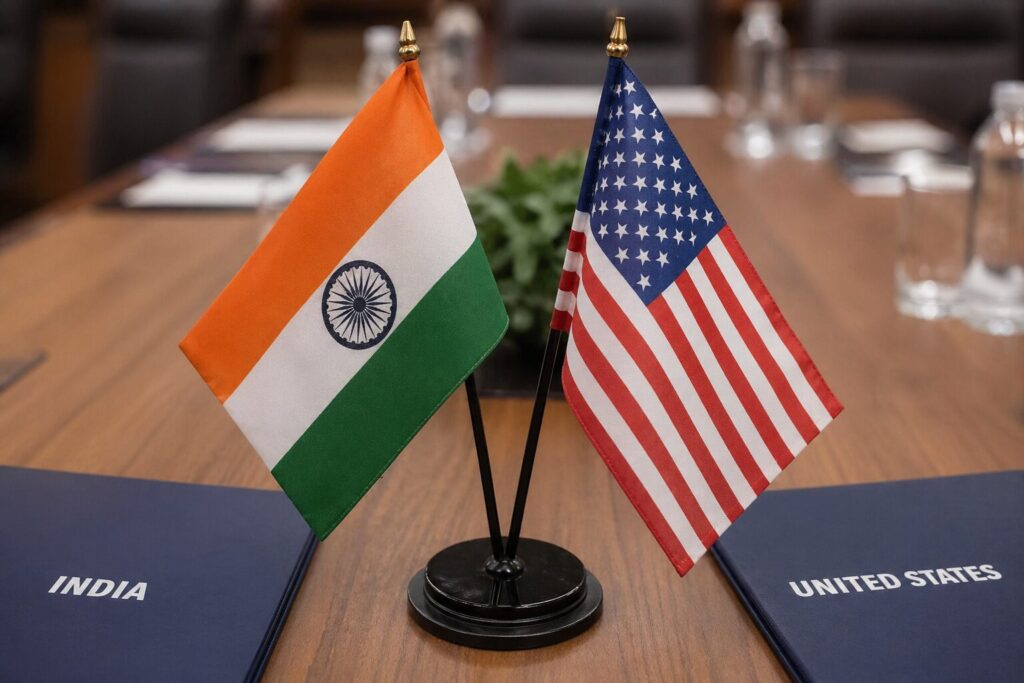
On February 2, 2026, Prime Minister Narendra Modi and US President Donald Trump announced what both sides called a landmark trade breakthrough. After months of painful tariff escalation that had pushed US duties on Indian goods to a staggering 50%, the two largest democracies in the world announced a reset.
The key terms agreed in the White House Joint Statement were:
- The US would reduce reciprocal tariffs on Indian goods from 25% to 18%
- A punitive 25% penalty tariff — imposed because India was buying Russian oil — would be eliminated entirely
- India agreed to reduce or eliminate tariffs on a wide range of US industrial and agricultural goods
- India committed to purchasing $500 billion worth of US products over five years, including energy, aircraft, technology, and coal
- Both sides would begin negotiating a full Bilateral Trade Agreement (BTA)
For India’s exporters in textiles, leather, gems and jewellery, and pharmaceuticals, the deal was a lifeline. Under 50% tariffs, Indian goods had become severely uncompetitive in the American market. The 18% rate brought India broadly in line with other Asian economies.
Home Minister Amit Shah called it a “historic” deal. Commerce Minister Piyush Goyal said it would “open huge opportunities for our labour-intensive sectors.”
Both sides expected to formally sign the first tranche — called the Interim Agreement — by mid-March 2026.
That has not happened.
Why Has the Deal Not Been Signed Yet?
Three separate developments have derailed the timeline. Each one alone would have caused complications. Together, they have created a genuine impasse.
1. The US Supreme Court Struck Down Trump’s Tariffs
On February 20, 2026 — just two weeks after the India deal was announced — the US Supreme Court ruled that the legal basis for Trump’s entire “reciprocal tariff” framework was unconstitutional. The administration had invoked the International Emergency Economic Powers Act (IEEPA) to impose tariffs. The Court found this was not a valid use of that law.
Within hours, Washington replaced the targeted tariff system with a flat 10% duty applied to all trading partners worldwide.
This created an immediate problem for India. The February deal had been negotiated under the old tariff architecture — where India faced 50% and the deal brought it down to 18%. Now, with a flat 10% applying to everyone, India would actually be paying more under the terms of the deal it agreed to than under the new universal baseline.
New Delhi’s commerce secretary Rajesh Agrawal stated publicly: “Actual signing of India-US trade deal will be done when the new architecture of tariffs is in place.”
2. The US Launched a Section 301 Investigation Into India
On March 11, 2026, the US Trade Representative (USTR) launched fresh Section 301 trade investigations targeting 16 economies including India. The probe examines what Washington calls “structural excess capacity and production” in Indian manufacturing.
The sectors under the microscope include solar modules, petrochemicals, steel, textiles, healthcare goods, construction materials, and automotive products — accounting for roughly $32.5 billion in Indian exports to the US, or about 38% of India’s total exports to America.
The implications are serious. If the investigation concludes against India, the US could impose new punitive tariffs — potentially wiping out the gains from the February deal entirely.
One unnamed Indian government source told Reuters: “We are not in a hurry to sign any deal. This is a pressure tactic to force countries into signing deals after the court order. It’s a spanner in the works.”
Analysts largely backed India’s caution. Priyanka Kishore of Asia Decoded remarked: “If you are at 10% tariff and these investigations are going through, it is better to hold out and see what they come up with, rather than proactively sign an agreement.”
3. The Iran War Is Distracting Diplomatic Bandwidth
The ongoing US-led conflict with Iran has pulled senior American foreign policy attention away from trade negotiations. India’s reliance on Russian crude oil has also complicated matters — India’s Russian oil imports actually rose to nearly 50% of total crude purchases in March 2026, up from 35% earlier, partly because Middle East supply disruptions caused by the Iran war made Gulf alternatives less accessible.
One of the core conditions of the February deal was India reducing its Russian oil purchases. Washington is watching this closely.
Where Do Negotiations Stand Right Now?
On April 20–23, 2026, Indian and American trade negotiators met in Washington D.C. for the first face-to-face talks since October 2025. The meetings were described as “constructive” but no breakthroughs were announced and no deadline was set.
Topics on the table included reducing customs delays, easing non-tariff barriers on electronics and pharmaceuticals, and aligning digital trade standards. Both sides committed to continuing negotiations, but no firm date for signing was given.
Mark Linscott, former Assistant US Trade Representative and senior advisor at the US-India Strategic Partnership Forum, has been direct about the stakes: “It’s critical that the agreement is sealed by the end of May. The only win-win for both the US and India would be to sign the interim agreement soon.”
That deadline is days away.
What Is at Stake for India?
The scale of what India stands to gain — or lose — from this deal cannot be overstated.
Export sectors at risk without a deal:
| Sector | Annual Exports to US | Risk Level |
|---|---|---|
| Textiles & Apparel | ~$9 billion | High |
| Pharmaceuticals | ~$13 billion | High |
| Gems & Jewellery | ~$10 billion | High |
| IT Hardware & Electronics | ~$11 billion | High |
| Engineering & Auto Parts | ~$6 billion | Medium |
Goldman Sachs analysts estimated that the February deal, if implemented, would provide an incremental GDP growth boost of 0.2 percentage points annually — modest but meaningful for an economy seeking every edge in a difficult global environment.
If the deal collapses and the Section 301 probe concludes against India, the outcome could be far worse. Targeted tariffs on India’s key export sectors could rise above 18% again, costing hundreds of thousands of jobs in India’s most labour-intensive industries.
The jobs picture: Estimates suggest a successfully signed and implemented deal could create 7.5 to 9 million direct jobs by 2030 across textiles, pharma, IT services, gems, and auto components. These are not abstract numbers — they represent workers in Surat’s diamond polishing units, Tiruppur’s garment factories, and Hyderabad’s pharmaceutical plants.
This connects directly to India’s broader economic story. For more context on India’s growth trajectory, read our analysis: India Economy by 2040: Will It Really Become a $10 Trillion Powerhouse?
What Happens If the Deal Fails?
A failure to sign — or a collapse of negotiations — would carry consequences across multiple dimensions.
1. Higher tariffs return. If the Section 301 investigation concludes without a signed deal, India could face new punitive measures. Washington has already demonstrated it is willing to push tariffs on India to 50%. There is no guarantee the current 10% flat rate stays in place permanently.
2. Competitive disadvantage widens. India is currently competing with Vietnam, Bangladesh, and Cambodia for US market share in textiles and manufacturing. If those countries sign deals that give them preferential tariff rates while India remains in limbo, Indian exporters lose ground that could take years to recover.
3. Strategic relationship suffers. The Stimson Center has noted that China, Russia, and Pakistan all made significant diplomatic gains during the 2025 period of India-US friction. A renewed breakdown in trade talks would hand India’s rivals another opening.
4. Indian farmers face uncertainty. One of the thorniest unresolved issues is US agricultural market access. Washington wants India to open its agricultural and dairy sectors to American goods. India’s farmers have historically and fiercely resisted this. Economist Biswajit Dhar, who has worked on several Indian trade deals, has called the American demands on agriculture “quite, quite disastrous” for Indian farmers. If talks collapse over this issue, it signals that the structural incompatibilities between the two economies remain unresolved.
5. Rupee and market volatility. Indian equity markets already saw $19 billion in foreign portfolio outflows in 2025 amid trade uncertainty. A collapse in 2026 negotiations could trigger a fresh round of capital flight.
What Are the Risks Even If the Deal Gets Signed?
It is worth noting that signing the deal is not a clean win either. Several economists and analysts have raised serious concerns about what India is giving up.
Russian oil dependency: India saves approximately $5 billion annually by buying discounted Russian crude. Shifting to US or Venezuelan oil at market prices could widen India’s current account deficit significantly.
Agricultural sector exposure: If India is ultimately pressured to open its dairy and poultry sectors to highly subsidised American goods, the impact on Indian farmers could be severe. This is politically explosive territory — and a key reason why Indian negotiators have resisted firm commitments on agriculture.
IP law alignment: Future negotiations toward a full BTA may require India to align its intellectual property laws with US standards — a move that could affect access to affordable generic medicines, which millions of Indians depend on.
The $500 billion question: Trump claimed India committed to purchasing $500 billion in US goods. India’s total imports from the US currently stand at under $50 billion annually. A 900% increase in purchases would represent roughly 85% of India’s entire annual government budget. Most analysts consider this figure aspirational at best.
For context on India’s energy strategy and the Russian oil dilemma, see our earlier analysis: India De-dollarisation Explained 2026
India’s Position: Strategic Patience
The Modi government’s approach so far has been one of deliberate patience — waiting for clarity on the US tariff framework before committing. External Affairs Minister S. Jaishankar reinforced this posture at the Munich Security Conference in February 2026, stating that India’s decisions would be guided by “calculations of economic interest and national priorities rather than external pressure.”
This is not obstruction. It is negotiation. India is the world’s fastest-growing major economy, with GDP growth of 7.6% in FY26 according to the World Bank’s April 2026 India Development Update. New Delhi knows it is a valuable partner for Washington — particularly as the US seeks to build supply chains that are not dependent on China.
But the clock is ticking. The Section 301 probe is moving forward. The US is pressing for India to cut Russian oil. And every week the deal remains unsigned is a week of uncertainty for Indian exporters trying to plan shipments and pricing.
Key Dates to Watch
| Date | What to Watch |
|---|---|
| End of May 2026 | Expert-set deadline for signing Interim Agreement |
| Q3 2026 | Expected completion of Section 301 investigation |
| Late 2026 / 2027 | Targeted timeline for full Bilateral Trade Agreement |
| April 30, 2026 | Deadline for India to phase out Russian oil imports (per initial deal terms) |
The Bottom Line
The India-US trade deal is one of the most consequential economic negotiations India has undertaken in decades. The February 2026 framework — whatever its flaws — represented a genuine de-escalation from a trade war that was actively costing Indian jobs.
The delay since then is not simply bureaucratic. It reflects real structural tensions: a US tariff system in legal limbo, a Section 301 investigation that could unravel what was agreed, a geopolitical conflict reshaping energy markets, and a fundamental disagreement over agriculture that neither side has yet resolved.
If the deal gets signed by the end of May — even in a modified form — India’s exporters get certainty, markets stabilise, and the two countries move toward a deeper strategic and economic partnership.
If it fails, India faces a return to tariff uncertainty, potential new punitive measures, and a loss of competitive position in its most important export market at a moment when it can least afford it.
For an economy with $10 trillion ambitions by 2040, the stakes of getting this right — or getting it wrong — could not be higher.
Also read:
- India Economy by 2040: Will It Really Become a $10 Trillion Powerhouse?
- India De-dollarisation Explained 2026: What It Is & Why It Matters
- India Slipped to 6th Largest Economy: Temporary Setback or Bigger Concern?
- Why Is Gold Price So High in India in 2026?
Sources: White House Joint Statement, February 9 2026 · CNBC — Iran War & Tariff Ruling Delay India Trade Deal, April 24 2026 · The Wire — Section 301 Investigation, March 12 2026 · World Bank India Development Update, April 2026 · Goldman Sachs — India Economy Outlook 2026 · Stimson Center Analysis · Business Standard — Section 301 Analysis, April 28 2026

I am an independent analyst and contributor at India2040, covering the intersection of Indian politics, economy, and public policy. I focus on electoral affairs, government policy, and India’s long-term growth story, with the aim of making complex national developments accessible to a wider audience. I am based in Gujarat and have been closely following Indian political and economic developments for several years. For queries or story tips, you can reach me at rohit@india2040.com
About The Author