
BJP Wins West Bengal Election 2026: How Mamata Banerjee Lost & What Happens to Bengal Now

Last Updated on June 1, 2026 12:16 pm by India2040 Desk
Something happened on May 4, 2026 that most political analysts said could not happen.
Mamata Banerjee — the fighter, the survivor, the woman who ended 34 years of Left rule in 2011 and fought off BJP twice before — lost West Bengal.
Not narrowly. Not controversially. By a landslide.
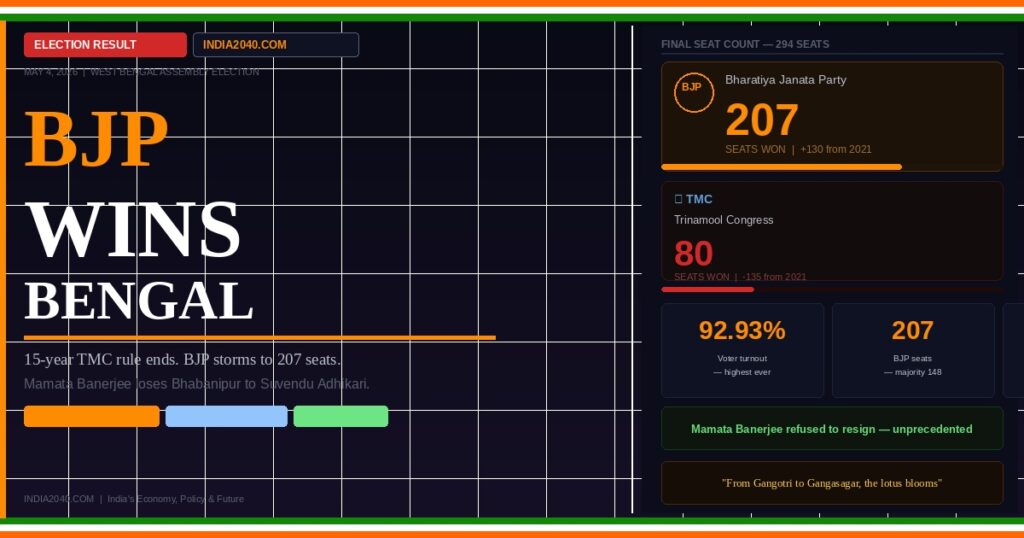
The BJP wins West Bengal Election 2026, they won 207 seats out of 294.
Mamata’s Trinamool Congress was reduced to just 80 seats — down from the 215 she had won in 2021. She even lost her own Bhabanipur constituency to the man she had beaten twice before — Suvendu Adhikari.
The West Bengal election result 2026 has redrawn India’s political map. Bengal — a state that had never elected a right-wing party since assembly elections began in 1937 — has done exactly that.
This article tells you the full story: the final numbers, the five real reasons Mamata lost, what happened in Bhabanipur, and what this historic West Bengal election result means for Bengal’s future.
The Final Numbers: West Bengal Election Result 2026
Here is a clear breakdown of what happened on counting day:
| Party | Seats Won (2026) | Seats Won (2021) | Change |
|---|---|---|---|
| BJP | 207 | 77 | +130 |
| TMC (Trinamool Congress) | 80 | 215 | -135 |
| Congress-Left Alliance | ~5 | ~1 | Marginal |
| Others | ~2 | 1 | — |
| Majority mark | 148 | — | — |
The BJP’s 207-seat victory is not just a win. It is a complete political transformation of West Bengal.
For context: in 2021, BJP had 77 seats and was seen as the rising challenger. In 2019 Lok Sabha elections, they won 18 of 42 parliamentary seats. In 2026, they crossed 200 Assembly seats — a swing that political scientists will study for decades.
The voter turnout was 92.93% — the highest ever in West Bengal’s electoral history, surpassing even the historic 2011 election that ended Left rule.
What Makes This Result Historic
The West Bengal election result 2026 is historic for several reasons beyond just the seat count.
First right-wing government since 1937. West Bengal has been governed by the Left (1977–2011) and then TMC (2011–2026). BJP is now the first right-of-centre party to form the state government since assembly elections began in independent India.
Mamata lost her own seat. She lost Bhabanipur — the constituency she had chosen specifically as her safe seat after losing Nandigram in 2021. Losing her home turf to Suvendu Adhikari is not just a political defeat. It is a personal and symbolic humiliation.
Mamata refused to resign. In an unprecedented move in Indian democratic history, Mamata Banerjee refused to step down as Chief Minister despite losing both her seat and her party’s majority, alleging widespread irregularities in the election. This constitutional standoff has no clear precedent and will likely head to the courts.
The 15-year incumbency wall broke. Analysts had theorised that TMC’s welfare delivery machine — Lakshmir Bhandar cash transfers, Kanyashree, Swasthya Sathi — would protect it from anti-incumbency. It did not. The West Bengal election result 2026 proved that welfare schemes alone cannot overcome deep public anger at governance failures.
5 Real Reasons Mamata Banerjee Lost West Bengal 2026
Reason 1: The SIR Controversy — 60 Lakh Voters Removed
The most contested issue of this entire election was the Special Intensive Revision (SIR) of electoral rolls — and it may have been the single biggest factor in the result.
Before the 2026 election, the Election Commission of India conducted a special drive to clean up voter rolls across West Bengal. The SIR removed approximately 60 lakh (6 million) voter entries categorised as absent, shifted, dead, or duplicate. A further 27 lakh voters had their status pending before tribunals.
In total, about 9 million voters — nearly 12% of the electorate — were affected.
In 177 seats, the number of deleted voters exceeded the victory margins from the 2021 elections. Of these, TMC had previously won 120 seats while BJP had won 57. This time, the trend reversed significantly in favour of BJP.
TMC called the SIR a BJP conspiracy to remove minority and immigrant voters who supported them. BJP defended it as cleaning up fake entries and removing illegal migrants. The Supreme Court directed the Calcutta High Court to appoint judicial officers to oversee the process.
Some voters, especially Muslims and Bangladeshi refugees, feared that if they did not vote, it could create problems for their future voting rights or government benefits — driving even higher turnout among those who remained on the rolls.
The SIR’s impact on the final West Bengal election result 2026 remains disputed — but the numbers make a compelling case that it mattered.
Reason 2: The RG Kar Rape-Murder Case — Women’s Safety as a Voting Issue
In August 2024, a trainee doctor at RG Kar Medical College and Hospital in Kolkata was brutally raped and murdered. The case triggered massive protests across Bengal — and the country.
The horrific RG Kar Medical College rape-murder case became a symbol of the state’s failure in women’s safety, severely denting Banerjee’s image among educated female voters.
The irony was devastating for TMC. Mamata Banerjee had built her entire political identity around being a woman who stood for women. Her party had consistently fielded more women candidates than almost any other. Yet the RG Kar case shattered that image.
Urban educated women — who had historically supported TMC or the Left — shifted significantly in this election. This urban swing was visible in Kolkata and Howrah, where BJP made unexpected gains in constituencies it had never won before.
Reason 3: The School Recruitment Scam — Corruption on an Enormous Scale
Corruption allegations, including job-for-cash cases, played a crucial role in the TMC’s setback.
The West Bengal school teacher recruitment scam was not a minor issue. It involved the alleged sale of government teaching jobs in exchange for cash payments — affecting hundreds of thousands of aspiring teachers and their families across the state. The CBI arrested several TMC-linked officials. Former Education Minister Partha Chatterjee was arrested with crores in cash found at his aides’ homes.
For ordinary Bengali families who had spent years preparing for government jobs — only to see those jobs sold to the highest bidder — this was not an abstract corruption story. It was a personal betrayal. And it voted accordingly.
Reason 4: 15 Years of Governance Fatigue
Fifteen years is a long time to rule any state. And Bengal had visibly changed.
The “cut-money” system — where local TMC workers took a percentage of government scheme payments from beneficiaries — had become widely known and widely resented. The “syndicate” system of extracting money from construction and business had made doing anything in Bengal more expensive.
Economic concerns and unemployment shaped voter mood. The people of Bengal appeared to be yearning for poriborton (change), as concerns over youth unemployment and the persistent lack of industrial growth had weighed heavily on voters for decades.
Industries had not returned to Bengal despite repeated promises. Young graduates were leaving the state to find work elsewhere. The welfare schemes — Lakshmir Bhandar, Kanyashree — were real and valued. But they were not enough to mask the bigger picture of a state that had not attracted meaningful investment in 15 years.
Reason 5: Suvendu Adhikari and BJP’s Booth-Level Organisation
Credit where it is due — BJP executed this election campaign with extraordinary precision.
BJP employed meticulous booth-level social arithmetic: mapping of Bengali Hindu and Hindi-speaking communities, ensuring a unified non-Muslim vote against TMC’s perceived minority appeasement, and leveraging Suvendu Adhikari’s reputation as the “giant killer.”
By fielding Adhikari in Bhabanipur — Mamata’s own seat — BJP forced her to spend enormous time and political energy defending her home turf instead of campaigning across the state. It was a strategic masterstroke.
BJP’s gains also came from Muslim-majority constituencies in Murshidabad, Malda, and North Dinajpur — stemming from a consolidation of Hindu votes alongside a split in TMC’s Muslim support, with votes fragmenting among Congress, CPI-M, and smaller parties.
The Hindu vote consolidated. The Muslim vote fragmented. And the result was 207 seats.
The Bhabanipur Upset: How Suvendu Beat Mamata in Her Own Backyard
Of all the individual results in the West Bengal election 2026, nothing symbolises the BJP’s victory more than what happened in Bhabanipur.
Mamata Banerjee had chosen Bhabanipur as her “safe seat” after her defeat in Nandigram in 2021. The constituency in south Kolkata has a composite electorate: around 42% Bengali Hindus, 34% non-Bengali Hindus, 24% Muslims, and significant migrant communities from Bihar, Odisha, and Jharkhand.
Between 47,000 and 51,000 names were deleted from Bhabanipur’s voter lists in the SIR exercise. In a seat where winning margins had been steadily narrowing — from the landslide 2021 bypoll to a slimmer lead in the 2024 Lok Sabha — even a minor alteration in the voter pool was consequential.
Observers point to a pivotal moment when Mamata walked off a stage in Bhabanipur after being disrupted by a nearby BJP rally, pleading with voters: “If you can, vote for me.” To many, this was the first sign that the veteran politician knew her stronghold was crumbling.
Suvendu Adhikari won. Mamata Banerjee — who had governed West Bengal for 15 years — lost her own seat.
Mamata Refuses to Resign — A Constitutional Crisis
What happened after the results is equally unprecedented.
In a move unprecedented in Indian politics, Mamata Banerjee refused to resign her office despite losing her seat and a majority in the assembly, alleging irregularities in its conduct.
Her argument: the SIR illegally removed legitimate voters, the election was not free and fair, and she will not step down until the courts examine the matter.
Constitutionally, a Chief Minister who loses their assembly seat must resign — or find another seat within six months. Banerjee’s refusal has put the Governor of West Bengal, the Election Commission, and the courts in a difficult position. The matter is expected to be challenged immediately in the Calcutta High Court and possibly the Supreme Court.
Whatever the courts decide, this constitutional standoff adds another extraordinary chapter to an already extraordinary election.
What Now? What the BJP Win Means for West Bengal
For Bengal’s Economy
A BJP government in Bengal will almost certainly bring a significant change in the investment climate. Modi’s central government has been reluctant to fund major projects in TMC-ruled Bengal. That friction disappears now.
BJP has promised industrial revival, manufacturing zones, and faster clearances for businesses. Tata Motors, which famously left Bengal after the Nano car plant controversy in 2008, could return. The state’s massive port at Haldia could see renewed investment.
The question is whether BJP can actually deliver on economic promises — or whether Bengal’s structural challenges (labour laws, land acquisition, political culture) will prove difficult to change quickly.
For Welfare Schemes
TMC’s flagship welfare schemes — Lakshmir Bhandar, Kanyashree, Swasthya Sathi — have real beneficiaries. Millions of families depend on them. BJP will be under political pressure to continue them, even if it rebrands them.
Scrapping popular welfare schemes in a state where you just won would be politically reckless. Expect continuity with rebranding — “BJP’s version” of welfare delivery.
For Bengal’s Politics
TMC’s road back is long and uncertain. With only 80 seats, it is a weakened opposition. Mamata — at 71 — faces the hardest question of her political career: does she fight on, or does she step back?
The Congress-Left alliance, which was hoping to fill the opposition space, has been largely irrelevant. Bengal’s opposition politics will need to rebuild from scratch.
For India’s National Politics
A BJP West Bengal changes the national equation. INDIA bloc loses one of its key state pillars. BJP now controls most of India’s large states — UP, Gujarat, MP, Rajasthan, and now Bengal. The opposition’s ability to present a credible alternative to Modi at the national level has become even harder.
India2040’s Honest Take: What This Election Really Tells Us
The West Bengal election result 2026 is the story of a political movement that ran out of time.
Mamata Banerjee genuinely transformed Bengal after 2011. She ended Left violence. She brought welfare to the poor. She gave Bengali women a political voice. These are real achievements that should not be erased by the final vote count.
But somewhere between 2011 and 2026, TMC forgot the most important lesson of politics: that voters are not grateful forever. They expect continuous improvement. When corruption became visible, when women became unsafe, when jobs did not come and young people left — the welfare cheques were no longer enough.
The BJP did not win Bengal because it is a better party. It won because it was the available alternative. Whether it uses this mandate to genuinely transform Bengal — bringing industry, jobs, and better governance — or simply replaces one set of problems with another, will determine whether this result is remembered as a turning point or just another political cycle.
Bengal is watching. India is watching.
Also Read — From India2040
- 🔗 West Bengal Election 2026: Phase 1 Done — Who Is Winning?
- 🔗 What Is Gerrymandering? How Politicians Rig Elections Without Changing a Vote
- 🔗 Narendra Modi’s Report Card: What He Promised in 2014 vs What India Got
- 🔗 Delimitation Bill 2026: What It Is, Why South India Is Furious & What Happens Next
- 🔗 Raghav Chadha Joins BJP: 7 AAP Rajya Sabha MPs Quit in Biggest Blow to Kejriwal
External Sources
- Republic World — West Bengal Election Results 2026 Live: BJP Wins 206 Seats
- Wikipedia — 2026 West Bengal Legislative Assembly Election
- The Federal — Deciphering BJP’s Landmark Victory in Bengal
- Organiser — How Suvendu Adhikari Toppled Mamata Banerjee in Bhabanipur
- Free Press Journal — BJP’s Spectacular Win Marks a Tectonic Shift
- Election Commission of India — Official Results
📢 Disclaimer: This article is published for informational and educational purposes only. All electoral data, seat counts, and political analysis are sourced from publicly available, credible sources including the Election Commission of India, Wikipedia, Republic World, The Federal, and Organiser. India2040 does not endorse or oppose any political party, candidate, or electoral outcome. The analysis and opinions expressed are based on publicly available information and represent independent editorial judgment. Readers are encouraged to form their own independent political opinions. India2040 is an independent media publication not affiliated with any political organisation, party, or government body.
Published on India2040 | india2040.com — India’s Economy, Policy & Future Category: Politics & Policy | Focused Keyword: West Bengal election result 2026 BJP wins | Word count: ~1,950 words

India2040 Desk is the editorial team of India2040, covering technology, startups, business, infrastructure, trade, and innovation shaping India’s future. The team focuses on reporting developments that contribute to India’s growth, digital transformation, and long-term vision toward 2040.
About The Author