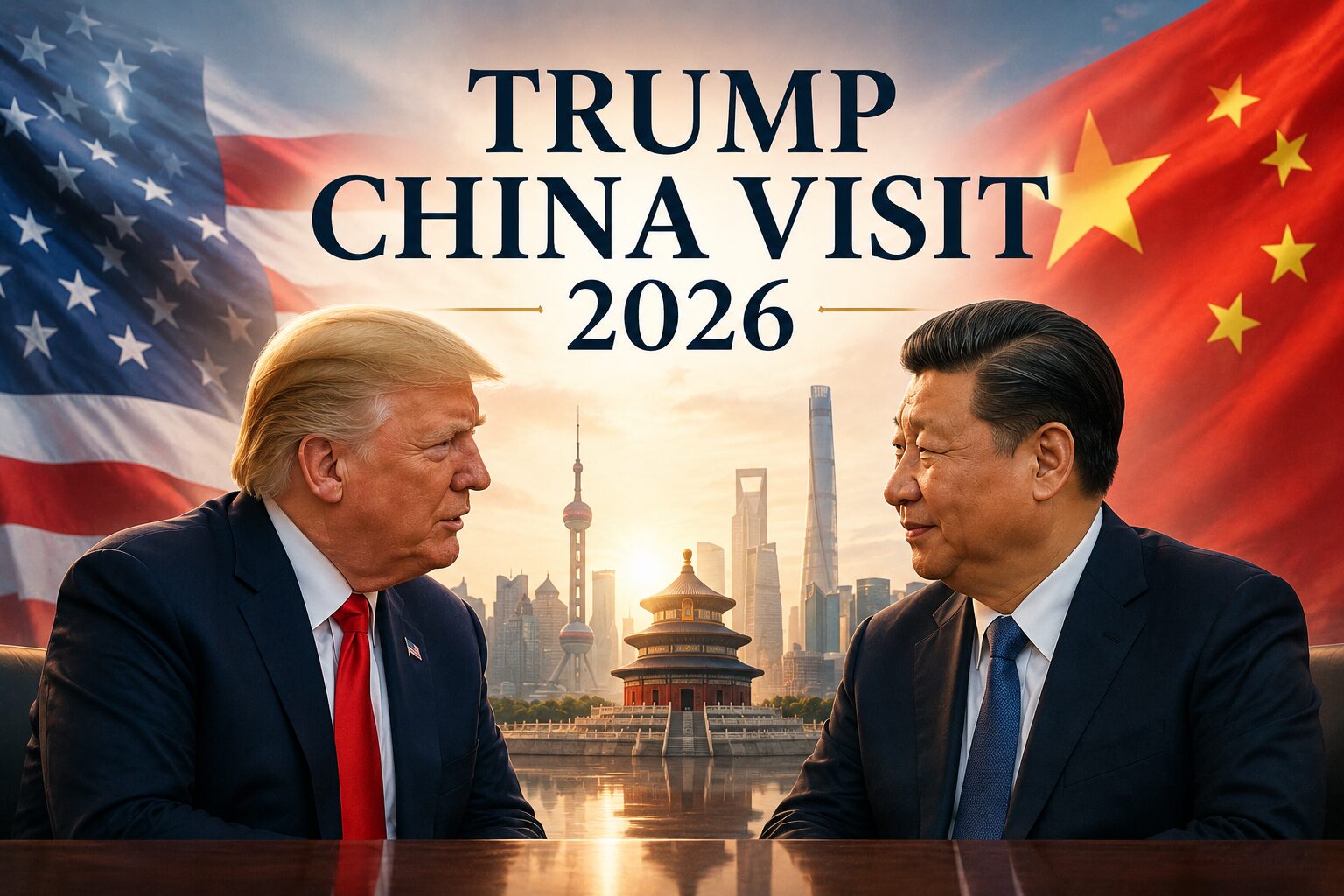
Trump China Visit 2026: Everything That Happened in Beijing — Deals, Warnings, and What It Means for India
Last Updated on May 31, 2026 9:04 pm by Rohit Gadhia
The Trump China visit 2026 was three days that the world will not forget quickly. Donald Trump flew to Beijing. Xi Jinping rolled out the red carpet. Elon Musk and Tim Cook came along for the ride. And the whole world — including India — watched with a mixture of hope, anxiety, and deep uncertainty about what would come out of it.
Here is the full story: what happened, what was agreed, what was not, and what the Trump China visit 2026 means for everyone going forward.
Why the Trump China Visit 2026 Was Such a Big Deal
Let us start with context, because numbers tell the story better than words.
The United States and China together account for roughly 43% of global GDP. Every major supply chain on the planet runs through one of these two countries, or both. When they fight, the world pays the price — in inflation, in energy shocks, in disrupted trade. When they talk, markets breathe easier and ships move more freely.
The Trump China visit 2026 — from May 13 to 15 — was the first time a US president had set foot in China in nearly nine years, since Trump’s own 2017 trip during his first term. It was also the first China visit of Trump’s second presidency, making it one of the most anticipated diplomatic events in years.
The two countries had spent much of the past two years locked in an escalating trade war, a technology battle over semiconductors and AI, and a dangerous standoff over Taiwan. Then came the Iran war in late February 2026 — an event that threw global energy markets into chaos and suddenly gave both Washington and Beijing powerful reasons to sit down together.
The Trump China visit 2026 was not optional for either side. It was necessary.
The Arrival: How Beijing Welcomed Trump in 2026
Trump landed at Beijing Capital International Airport on the evening of May 13 to a scene designed to impress — and calculated to send a message.
Three hundred Chinese children in matching blue and white uniforms lined the tarmac, waving American and Chinese flags. A military honour guard stood at attention. A military band played. The red carpet was, literally, red.
But there was a signal buried inside all that pageantry. Xi Jinping did not come to the airport himself. He sent Chinese Vice President Han Zheng — a retired member of the Politburo Standing Committee and Xi’s usual envoy for important diplomatic occasions. You are important enough for a formal welcome, the gesture said, but not important enough for the top man personally.
Some China watchers read this as Beijing making clear that the Trump China visit 2026 was happening on China’s terms, not Washington’s.
Travelling with Trump was a delegation that was extraordinary by any measure:
- Secretary of State Marco Rubio — a person under Chinese sanctions, travelling to Beijing for the first time
- Defence Secretary Pete Hegseth — the first US Secretary of Defense ever to accompany a president on a China state visit
- Treasury Secretary Scott Bessent
- Elon Musk (Tesla) and Jensen Huang (Nvidia) — both flew on Air Force One itself
- Tim Cook (Apple), Larry Fink (BlackRock), Stephen Schwarzman (Blackstone), Larry Culp (GE), Kelly Ortberg (Boeing), Dina Powell McCormick (Meta), and several others — over 16 CEOs in total
The presence of 16+ top American business executives during the Trump China visit 2026 sent its own unmistakable message: Corporate America still sees China as indispensable, regardless of the political noise in Washington.
The Four Big Issues at the Trump China Visit 2026
1. Trade: Boeings, Beef, and Beans
Trade was Trump’s primary stated goal for the China visit 2026 — and he came wanting deals.
The most headline-grabbing announcement to emerge from the Trump China visit 2026 was that China agreed to purchase 200 Boeing aircraft. This would be the first significant Chinese purchase of American aircraft since Trump’s 2017 Beijing trip, when China had agreed to buy 300 planes — a commitment that ultimately never fully materialised.
“I think it was a commitment,” Trump said in a Fox News interview filmed in Beijing. The careful phrasing — “I think” — was noticed immediately by analysts watching the Trump China visit 2026 closely.
Beyond Boeing, both sides agreed to:
- Open China’s market to US beef imports — a longstanding Washington demand
- Discuss billions of dollars in Chinese purchases of US agricultural products
- Establish a bilateral trade council and investment council for ongoing negotiations
- Continue the tariff reduction framework from October 2025, where the US lowered duties on Chinese goods in exchange for China pausing rare earth export restrictions
Trump declared the outcomes of the Trump China visit 2026 as “fantastic trade deals — great for both countries.” China’s official readout was considerably more cautious, describing “overall balanced and positive outcomes” — diplomatic language that deliberately stopped short of confirming any specific numbers.
US soybean futures fell slightly after the summit ended because no firm agricultural commitments with concrete timelines emerged from the Trump China visit 2026.
2. Taiwan: The Most Dangerous Conversation of the Trump China Visit 2026
If trade was what Trump came for, Taiwan was what Xi Jinping needed to talk about.
Xi described Taiwan as “the most important issue in China-US relations” — and said so at the very start of the closed-door meeting, before any other topic was raised. It was a deliberate move, establishing the red line before anything else was discussed.
Xi’s warning during the Trump China visit 2026 was unambiguous. He told Trump that if the Taiwan issue was mishandled, it could push the entire relationship “into a highly perilous situation” — and that the two nations could “collide or even come into conflict.”
The Trump administration had approved an $11 billion arms package to Taiwan in December 2025 but had not moved forward with delivery. During the Trump China visit 2026, Trump told Fox News that the pending $14 billion Taiwan arms deal was “a very good negotiating chip” — a comment that alarmed Taipei and delighted Beijing.
“I haven’t approved it yet. We’re going to see what happens,” Trump said.
Asked directly whether the US would defend Taiwan if China attacked, Trump told reporters on Air Force One returning from the Trump China visit 2026: “I made no commitment either way.”
Taiwan’s foreign minister responded by saying Taipei would seek to deepen ties with the US, citing increasing regional “risks.” The Taiwan situation ended the summit exactly as it began — unresolved, tense, and dangerous.
3. Iran: The Energy Crisis That Dominated the Trump China Visit 2026
The US-Israeli war against Iran, which began on February 28, 2026, was not originally the centrepiece of the Beijing agenda. It became one of the defining themes of the Trump China visit 2026 anyway.
Iran had largely blocked shipping through the Strait of Hormuz since the outbreak of war — a chokepoint that normally carries around a fifth of the world’s oil and liquefied natural gas. The International Energy Agency had described the resulting disruption as “the worst energy crisis in history.”
Trump came to Beijing wanting Xi to use China’s enormous leverage over Tehran — China is Iran’s largest oil customer — to push for the Strait to reopen.
The White House readout of the Trump China visit 2026 stated that “both sides agreed that the Strait of Hormuz must remain open to support the free flow of energy.” Xi said China opposed the militarisation of the Strait and expressed interest in buying more American oil to reduce China’s own dependency on Iranian routes.
But Xi made no firm commitment to directly pressure Tehran.
Trump, clearly aware he had not extracted a specific promise, told reporters he was “not asking for any favours, because when you ask for favours, you have to do favours in return.”
One quiet development: some Chinese vessels reportedly began passing through the Strait in the days following the Trump China visit 2026, with Iran stating it was “with Iran’s permission” — suggesting some limited diplomatic coordination had occurred behind the scenes, even without a public announcement.
4. Artificial Intelligence and Technology
Running beneath the headline issues of the Trump China visit 2026 was a quieter but enormously consequential battle over artificial intelligence and advanced semiconductors.
Jensen Huang of Nvidia had not originally been invited to join the delegation. He flew to Anchorage specifically to board Air Force One — a deliberate last-minute addition whose significance was not lost on observers of the Trump China visit 2026.
Reports circulated that the US was considering allowing up to 10 Chinese companies to purchase advanced Nvidia chips critical to AI development — chips that had been blocked under export controls. Treasury Secretary Bessent declined to confirm this publicly.
The technology contest between the two countries is long-term and structural. It will not be resolved in a three-day summit — but the Trump China visit 2026 made clear that AI is now a central bargaining chip on the table.
The Diplomatic Choreography: Who Actually Won the Trump China Visit 2026?
Diplomatic summits are as much about symbolism as substance — and the symbolism of the Trump China visit 2026 was revealing.
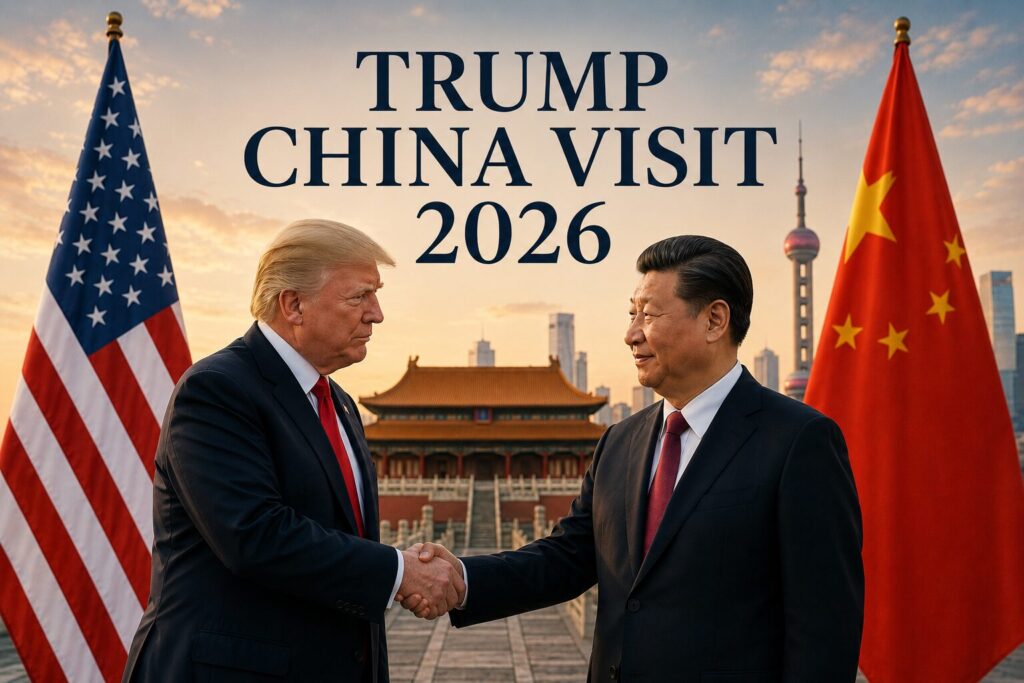
Xi met Trump at Zhongnanhai — China’s most secretive and exclusive leadership compound, the equivalent of welcoming someone into your private home. The two leaders also visited the Temple of Heaven, a fifteenth-century Confucian site — only the second US president to do so while in office, after Gerald Ford in 1975. These were settings chosen by China, designed to convey historical depth and civilisational confidence.
Xi’s framing throughout the Trump China visit 2026 was notable. He did not position himself as a supplicant seeking relief from American tariffs. He cast the relationship as one between two equal great powers navigating a transforming world together.
Several analysts who studied the Trump China visit 2026 closely concluded that Beijing entered and left the summit from a position of quiet confidence — not supplication. China had resisted Trump’s tariff escalations, retaliated with rare earth restrictions, and watched American corporate leaders fly to Beijing to protect their business interests. “The Americans realised that China is a hard nut to crack,” as one Indian analyst put it bluntly.
The viral image from the Trump China visit 2026 that circulated afterward — showing members of the American delegation reportedly discarding Chinese-issued items near the staircase of Air Force One before departure — was a small but telling moment. The suspicion ran both ways.
What Was Agreed vs. What Was Actually Confirmed — The Honest Scorecard
Here is an honest summary of where things stood when Trump boarded Air Force One home from the Trump China visit 2026:
| Issue | Trump’s Claim | China’s Readout | Reality Check |
|---|---|---|---|
| Boeing aircraft | China agreed to buy 200 planes | Not in Chinese statement | Unconfirmed; may repeat 2017 pattern |
| Agricultural imports | Billions in purchases expected | “Balanced positive outcomes” | No specific numbers or timelines |
| Strait of Hormuz | Progress, shared desire to open | China “encourages” resolution | No firm pressure on Iran committed |
| Taiwan arms deal | “Great negotiating chip,” undecided | Taiwan is the core issue | No progress; situation more dangerous |
| AI / Nvidia chips | Under consideration | Not confirmed | Informal only, no announcement |
| Xi US visit | Xi will visit US in the fall | Confirmed by China | Most concrete outcome of the summit |
| Trade & investment councils | Agreed to establish | Confirmed | Structural positive; long-term process |
The most concrete, tangible outcome of the entire Trump China visit 2026 was Xi Jinping’s agreement to visit the United States in the fall of 2026. That, at minimum, gives both sides an incentive to keep the relationship from blowing up before then.
What the Trump China Visit 2026 Means for India
India watched the Trump China visit 2026 more closely than almost any other country — and not entirely with comfort.
The India-US relationship has already been strained in Trump’s second term. Washington hit India with a 25% penalty tariff for buying Russian oil, while simultaneously going easier on China for doing the same. Trump publicly warned Apple not to manufacture smartphones in India. The “India as counterweight to China” narrative — which had anchored US-India strategic partnership for two decades — has visibly weakened.
The Trump China visit 2026 deepens New Delhi’s concerns in three specific ways:
The supply chain question. India has spent years positioning itself as the natural beneficiary of the “China+1” strategy — companies diversifying manufacturing away from China toward India. A US-China trade reset following the Trump China visit 2026 could slow or reverse this investment flow. If American companies become more comfortable operating in China again, the urgency to shift to India diminishes.
The energy crisis. India imports over 85% of its crude oil. The Iran war blockade has already pushed fuel prices up by ₹3 per litre in a single day. India desperately needs the Strait of Hormuz reopened — but has almost no direct leverage in that conversation. The Trump China visit 2026 produced only vague commitments on Iran, which is a problem for New Delhi.
The strategic positioning question. As Chatham House’s Chietigj Bajpaee noted after the Trump China visit 2026: “The narrative of India as a counterbalance to China has weakened under the Trump administration.” A warming US-China relationship could further reduce India’s strategic weight in Washington’s calculations, precisely when India needs that relationship most.
India’s best-case outcome from the Trump China visit 2026: a limited trade reset that does not fundamentally alter global investment patterns, combined with enough quiet progress on Iran to eventually reopen the Strait and ease the energy crisis.
The worst-case outcome: a deeper US-China reset that redirects American investment and diplomatic attention away from India, while the Strait blockade continues to hammer the Indian economy.
The Trump China visit 2026 produced neither. It produced ambiguity — which is, in some ways, the hardest outcome for India to plan around.
India2040’s Honest Take: What the Trump China Visit 2026 Really Achieved
The Trump China visit 2026 was historic in the theatrical sense. The guest list, the venues, the pageantry, the symbolism — all extraordinary. It brought together the leaders of the world’s two largest economies at a genuine moment of global crisis.
But for all the spectacle, the Trump China visit 2026 produced very little that is concrete, binding, or irreversible.
China did not commit to pressuring Iran. The Taiwan arms question remains unresolved. The Boeing aircraft agreement may follow the same trajectory as the 2017 commitment that was never fully delivered. The Nvidia chip question was left publicly unanswered.
What the Trump China visit 2026 did achieve is harder to measure but equally real. It established that Washington and Beijing can still talk directly. It moved the relationship from active deterioration toward cautious stabilisation. It gave Xi Jinping a fall US visit to look forward to — creating a structural incentive for both sides to avoid blowing up relations before then.
Xi’s reframing of the relationship — from US-defined “strategic competition” to jointly defined “constructive strategic stability” — was the quiet diplomatic coup of the Trump China visit 2026. China insisted on being treated as an equal, and Washington accepted those terms simply by showing up.
For India, the lesson from the Trump China visit 2026 is uncomfortable but important: in the world of great-power bargaining, being “useful” to a superpower is not the same as being valued by it. India must build leverage of its own — deeper capabilities, diversified partnerships, greater economic resilience — rather than relying on US-China friction to maintain its strategic relevance.
The world’s two largest economies have stepped back from the edge. That is good for global stability. Whether the Trump China visit 2026 ultimately proves good for India’s long-term interests depends entirely on what comes next — and on decisions that will be made in New Delhi, not Beijing or Washington.
Key Dates to Watch After the Trump China Visit 2026
| Date | What to Watch |
|---|---|
| Fall 2026 | Xi Jinping visits the United States — the main outcome of the summit |
| June 2026 | Expected decision on whether US delivers $14bn Taiwan arms package |
| Q3 2026 | Whether China’s Boeing and agricultural commitments become real orders |
| Ongoing | Iran ceasefire talks — Strait of Hormuz reopening timeline |
| 2026 onwards | First meetings of the new US-China trade and investment councils |
Also read from India2040:
- India-US Trade Deal: Why It’s Still Not Signed & What Happens If It Fails
- India De-dollarisation Explained 2026: What It Is & Why India Is Reducing Dollar Dependence
- India Economy by 2040: Will It Really Become a $10 Trillion Powerhouse?
- BJP Wins West Bengal 2026: How Mamata Banerjee Lost & What Happens to Bengal Now
Sources: CNN — Trump China Visit 2026 Live Coverage · Wikipedia — 2026 State Visit by Donald Trump to China · Al Jazeera — Trump Departs China, May 15 2026 · Euronews — Trump and Xi Wrap Up Summit · Deseret News — Expert Analysis of Trump China Visit 2026 · CNBC — Inside India: What Trump China Visit 2026 Means for New Delhi · The Federal — Trump China Visit 2026 Implications for India · Global Times — Trump Arrives in Beijing May 2026

India2040 Desk is the editorial team of India2040, covering technology, startups, business, infrastructure, trade, and innovation shaping India’s future. The team focuses on reporting developments that contribute to India’s growth, digital transformation, and long-term vision toward 2040.
About The Author